TECHNIQUE ARTICLE
Direct cholangioscopy using ultraslim endoscopes enables diagnostic and therapeutic interventions of the biliary tract. However, failure rates reach up to 15%, mainly due to cannulation difficulty. We present the novel concept of stent-assisted direct cholangioscopy.
Abstract
Background: Direct cholangioscopy using ultraslim endoscopes (i.e. pediatric gastroscopes or transnasal gastroscopes) enables diagnostic and therapeutic interventions of the biliary tract. However, DC is not always feasible with failure rates up to 15%, mainly due to cannulation failure. Entering the bile duct may be hampered by a stenotic bile duct and difficult scope position.
Case and Technique: A 76-year-old female patient was referred to our institution with obstructive jaundice due to complex biliary tract lithiasis, which could not be removed during the initial ERCP. After removing plastic stents and performing biliary sphincterotomy, a fully covered metal stent (10Fr 8cm) was placed in the bile duct. A 4.9 mm ultraslim scope was passed nasally and the bile duct was cannulated through the fcSEMS, achieving a direct stent-assisted cholangioscopy. The remaining stones were removed using DOC with basket.
Conclusion: Inserting a fully covered self-expanding metal stent allowed for direct biliary access using an ultraslim transnasal gastroscope, thus performing direct cholangioscopy. We present the novel concept of stent-assisted direct cholangioscopy.
Keywords: direct cholangioscopy; ERCP; fully covered metallic stent; stent-assisted cholangioscopy; ultraslim endoscope; biliary tract; choledocholithiasis
★ Key Clinical Takeaways
- Direct cholangioscopy using ultraslim endoscopes may fail in up to 15% of cases, mainly due to cannulation failure from a stenotic bile duct or difficult scope position.
- Placement of a fully covered self-expanding metal stent (fcSEMS) in the bile duct can facilitate direct biliary access by providing a channel for the ultraslim scope.
- Stent-assisted direct cholangioscopy is a novel technique that enables both diagnostic and therapeutic interventions of the biliary tract when conventional direct cholangioscopy is not feasible.
- This approach allowed successful removal of residual stones using direct observation cholangioscopy (DOC) with basket through the fcSEMS.
Case Presentation
Direct cholangioscopy using ultra slims endoscopes (i.e. pediatric gastroscopes or transnasal gastroscopes) enables diagnostic and therapeutic interventions of the biliary tract. However, DC is not always feasible with failure rates up to 15%, mainly due to cannulation failure. Entering the bile duct may be hampered by a stenotic bile duct and difficult scope position. Herein we present the novel concept of stent-assisted direct cholangioscopy.
A 76-year-old female patient was referred to our institution with obstructive jaundice due to complex biliary tract lithiasis, which could not be removed during the initial ERCP. At our hospital cholangiography revealed a very dilated, tortuous bile duct with filling defects in the common hepatic and right intrahepatic duct. At the referring hospital the stone could not be retrieved, and thus dual biliary stent insertion (7fr 15cm and 10Fr 5cm) was done. At our hospital ERCP performed 12 weeks later revealed a narrowed and fibrosed papilla. After removing the plastic stents and performing biliary sphincterotomy (panel A) an extraction balloon was used to sweep significant amount of debris out of the severely dilated bile ducts. Given the previous concern for stones and the severely dilated biliary tree, a fully covered metal stent (10Fr 8cm) (Cook Medical, USA) was placed in the bile duct (B). A 4.9 mm ultraslim scope was passed nasally into the stomach and duodenum and then the bile duct was cannulated through the fcSEMS, thus achieving a direct stent-assisted cholangioscopy (C). The remaining stones were removed using DOC with basket. No stones were left behind intraductally (C).
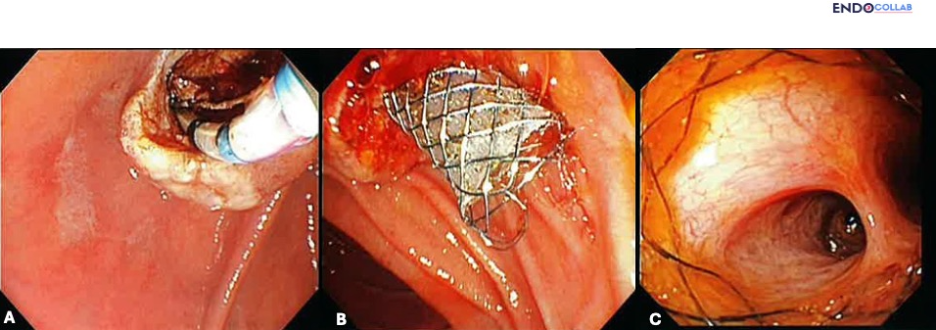
This case shows how inserting a fully covered self-expanding metal stent allowed for direct biliary access using an ultraslim transnasal gastroscope, thus performing direct cholangioscopy.