COMMUNITY DIGEST
3 featured cases and 12 quick consultations from the EndoCollab WhatsApp community between August 3 – August 31, 2026. A kinked gastroduodenal stent that the group helped salvage, severe esophagitis in diabetic ketoacidosis on the black-esophagus spectrum, and a biliogastric fistula found during workup of pneumobilia. Quick cases cover unconjugated-dominant acute liver failure, manometric EGJOO after a peptic stricture, and several stent and dilation problems.
In this issue
- Kinked Gastroduodenal SEMS after Malignant GOO: Salvage before GJ
- Severe Esophagitis in DKA: Grade D Plus or Black Esophagus
- Biliogastric Fistula with Pneumobilia and a Nondilated Duct
- Quick cases: EGJOO after peptic-stricture dilation; Rising bilirubin after a clean ERCP; Uphill versus downhill varices; Octreotide for dumping after mini-gastric bypass; Unconjugated-dominant ALF in shock; Stacked covered SEMS that both occluded; Uncovered pyloroduodenal stent against the ampulla; Blue rubber bleb lesions on enteroscopy; Ileocecal-valve polyp: EMR versus underwater; Post-cricoid web that will not take a scope; When to dilate a radiation esophageal stricture; Jejunal capsule erosions, NSAIDs denied
- Community notes: Checkpoint-inhibitor colitis that fails corticosteroids and…; Chromoendoscopy dye volumes used in the group: two 5 ml ampo…; Peutz-Jeghers polypectomy: inject a small saline cushion at…; Intralesional steroid has some support for Crohn strictures…; Rectal fecaloma: Coca-Cola instillation was the practical an…
Featured Cases
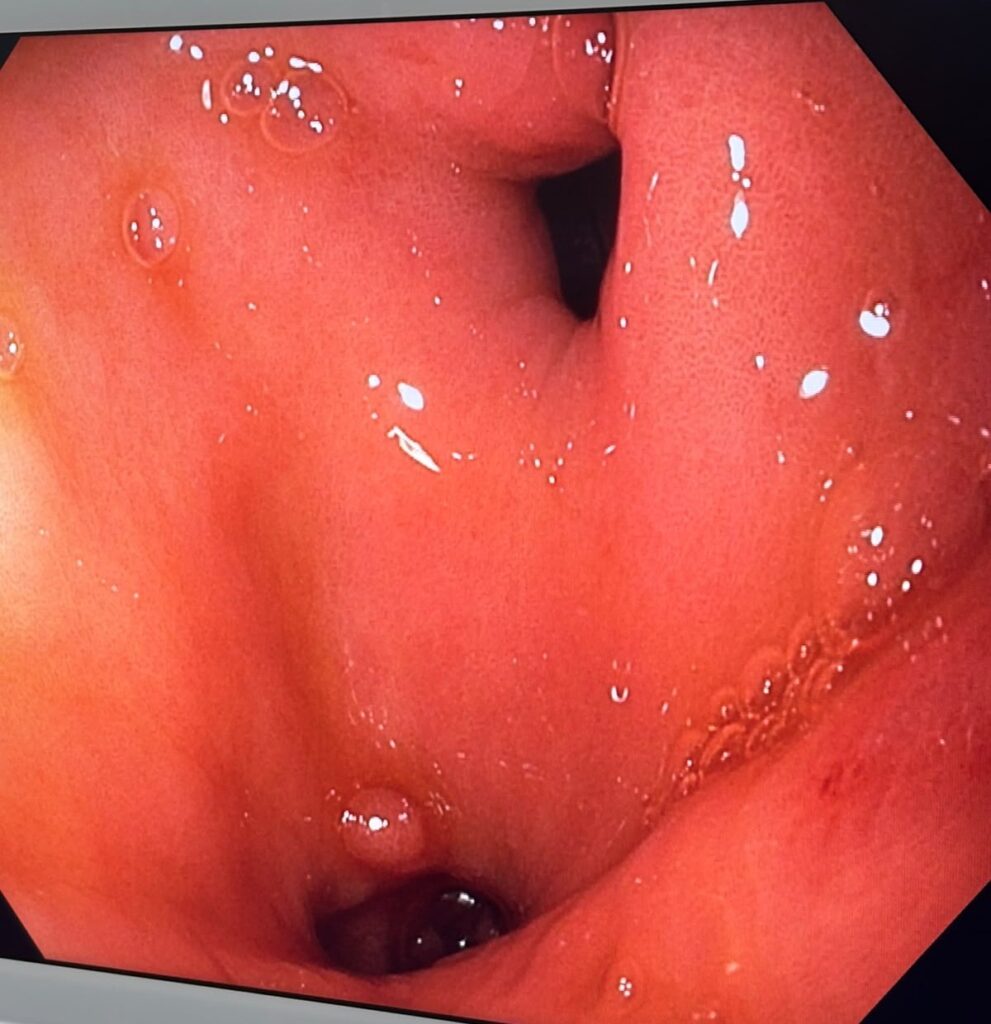
1. Kinked Gastroduodenal SEMS after Malignant GOO: Salvage before GJ
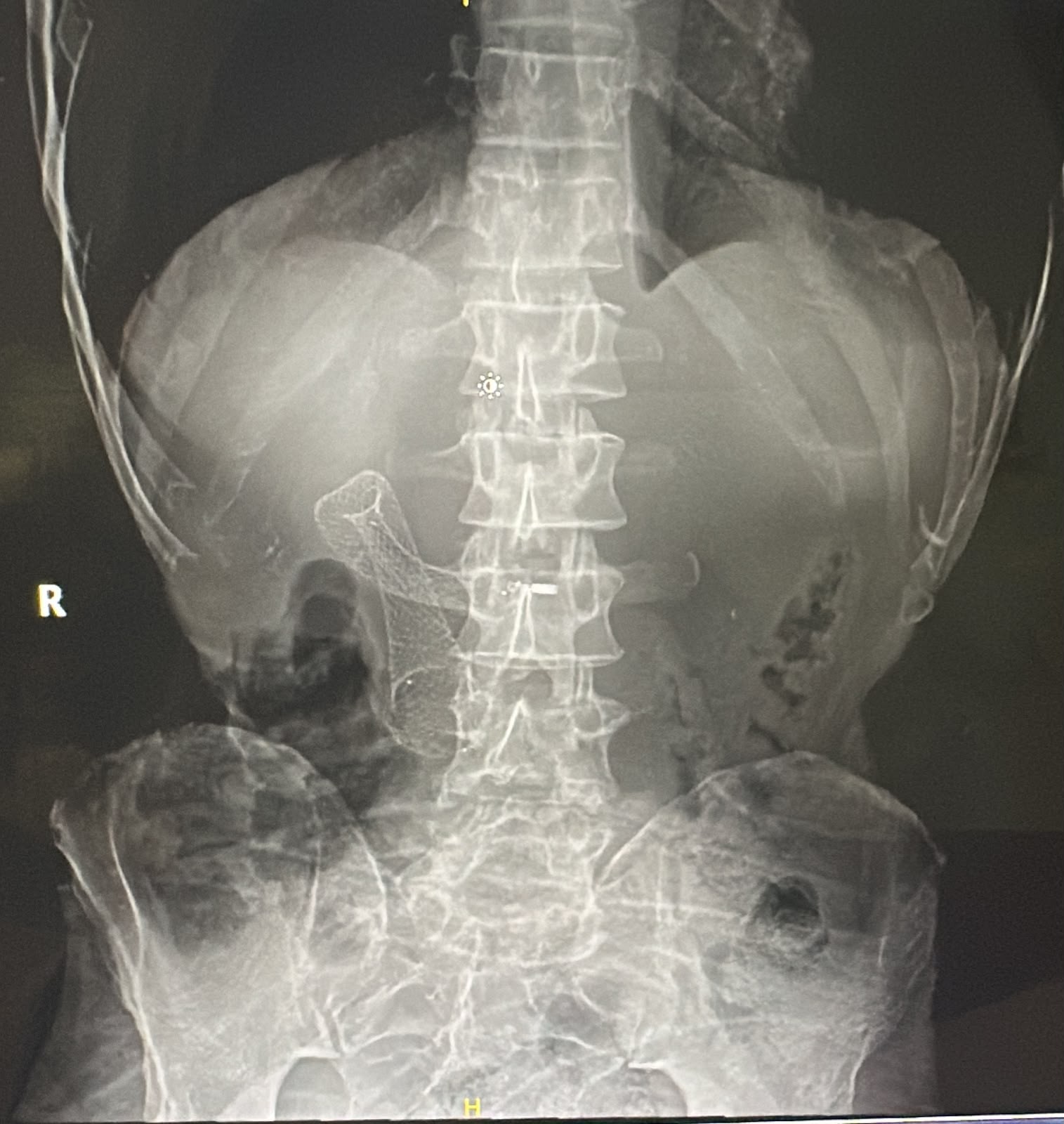
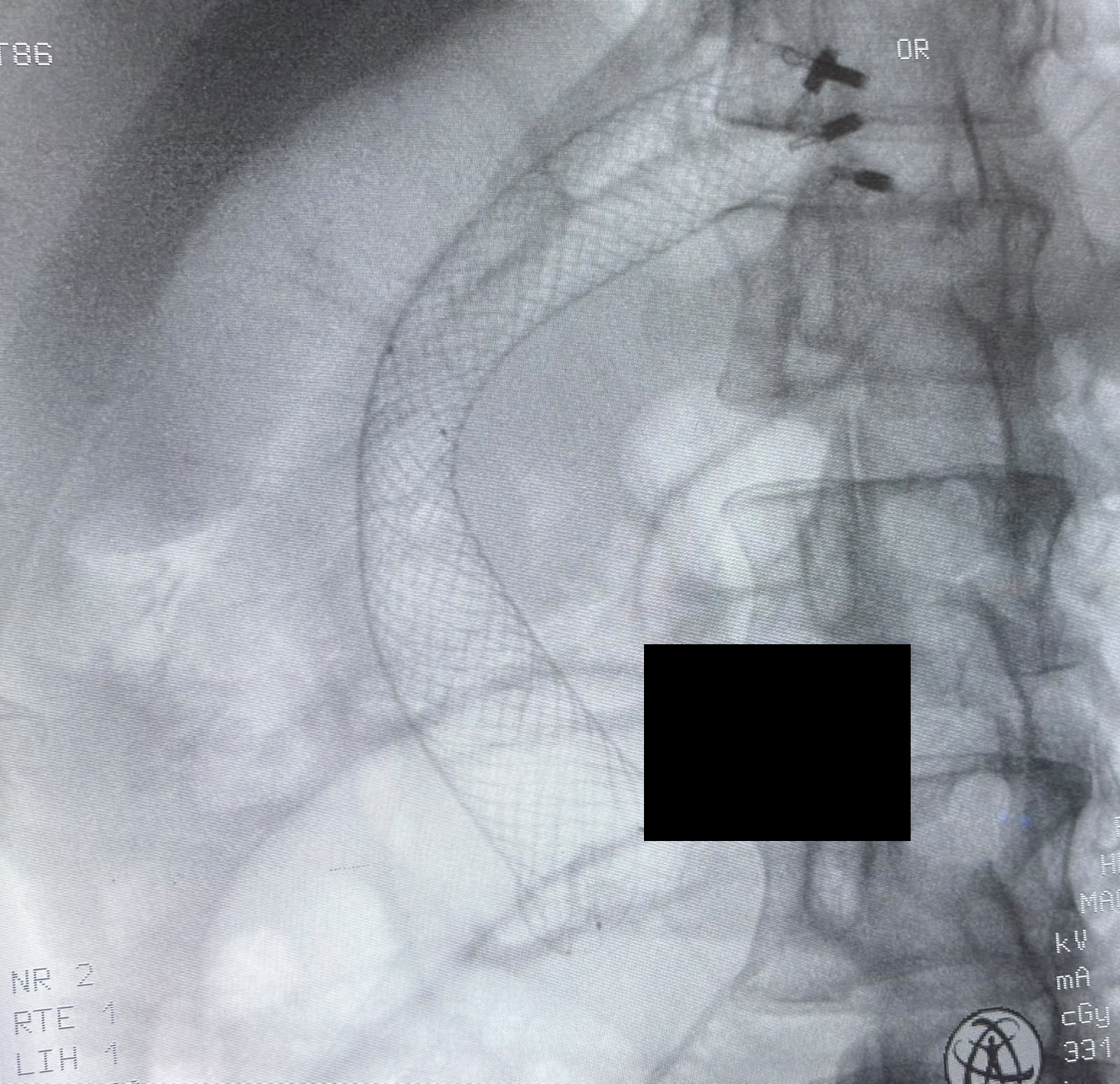
A partially covered 12 cm gastroduodenal SEMS was placed for malignant gastric-outlet obstruction. The 24-hour film looked acceptable and the patient took oral intake. At 48 hours vomiting returned. The second film was read as proximal migration with mid-stent kinking.
The group was pessimistic about straightening a severely bent uncovered segment once it had begun to embed. Suggestions: inflate a balloon inside the stent to try to conform it, pass a wire without going through uncovered mesh and overlap a second stent, or create an endoscopic gastrojejunostomy with a lumen-apposing metal stent if salvage failed.
Salvage succeeded the next day. The stent was repositioned, the kink was dilated with an 18 mm balloon, and three clips secured the proximal end. A single clip at the index procedure had not been enough. Vomiting stopped and oral intake resumed, though the patient's overall condition remained poor.
Clinical Pearl: A single proximal clip does not reliably stop a partially covered gastroduodenal SEMS from kinking. Attempt early reposition plus balloon dilation and additional clips if a wire path is safe. If the bend is fixed or uncovered mesh has embedded, move to endoscopic or surgical gastrojejunostomy rather than forcing a hopeless stent.
2. Severe Esophagitis in DKA: Grade D Plus or Black Esophagus
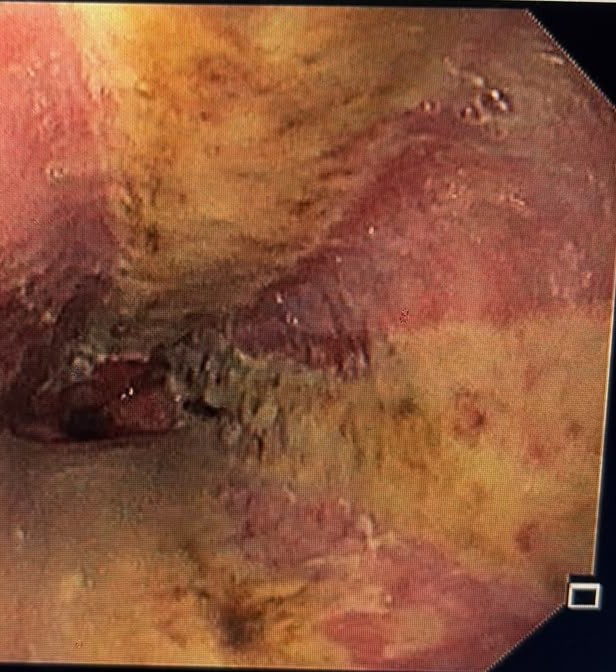
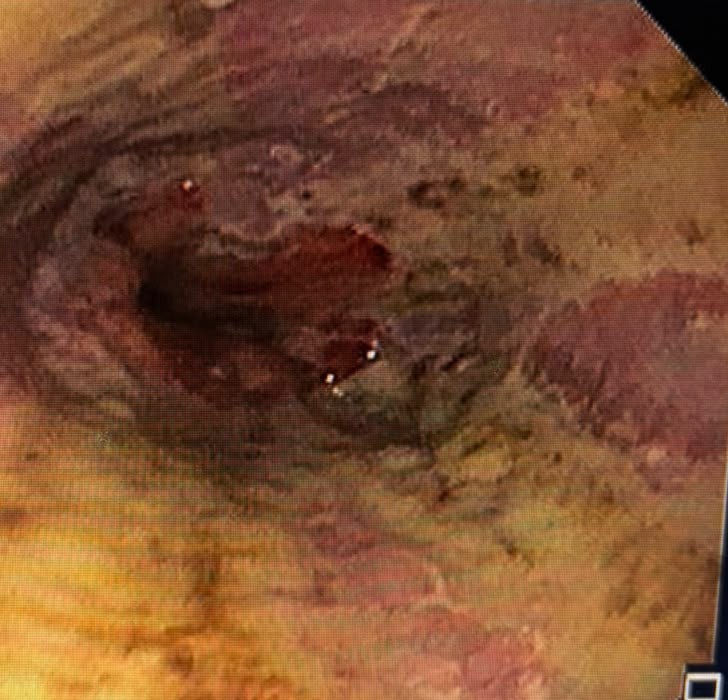
A 53-year-old woman admitted with diabetic ketoacidosis had odynophagia. She was on ocrelizumab for multiple sclerosis. There was no caustic ingestion. Endoscopy showed circumferential esophageal injury with islands of spared mucosa. The differential was LA-D reflux, candidiasis, caustic injury, and acute esophageal necrosis.
One teaching line framed DKA as a trigger for sudden severe gastroparesis, which then produces grade D plus reflux esophagitis. Another read the distal blackish change that stopped at the GE junction as a black-esophagus variant from hypoperfusion plus acid. A similar pattern was noted after cardiac surgery on bypass, with mucosal recovery often taking 8 to 12 weeks.
Biopsies were taken. Fluconazole was started while histology was pending, together with an intravenous PPI infusion. One member argued antifungal cover was unnecessary if the picture was purely reflux.
Clinical Pearl: DKA can produce severe, even necrotizing, esophagitis through acute gastroparesis and hypoperfusion. Spared mucosal islands do not exclude the black-esophagus spectrum. Support perfusion, suppress acid, and treat infection only when the visual pattern or pending histology warrants it.
3. Biliogastric Fistula with Pneumobilia and a Nondilated Duct
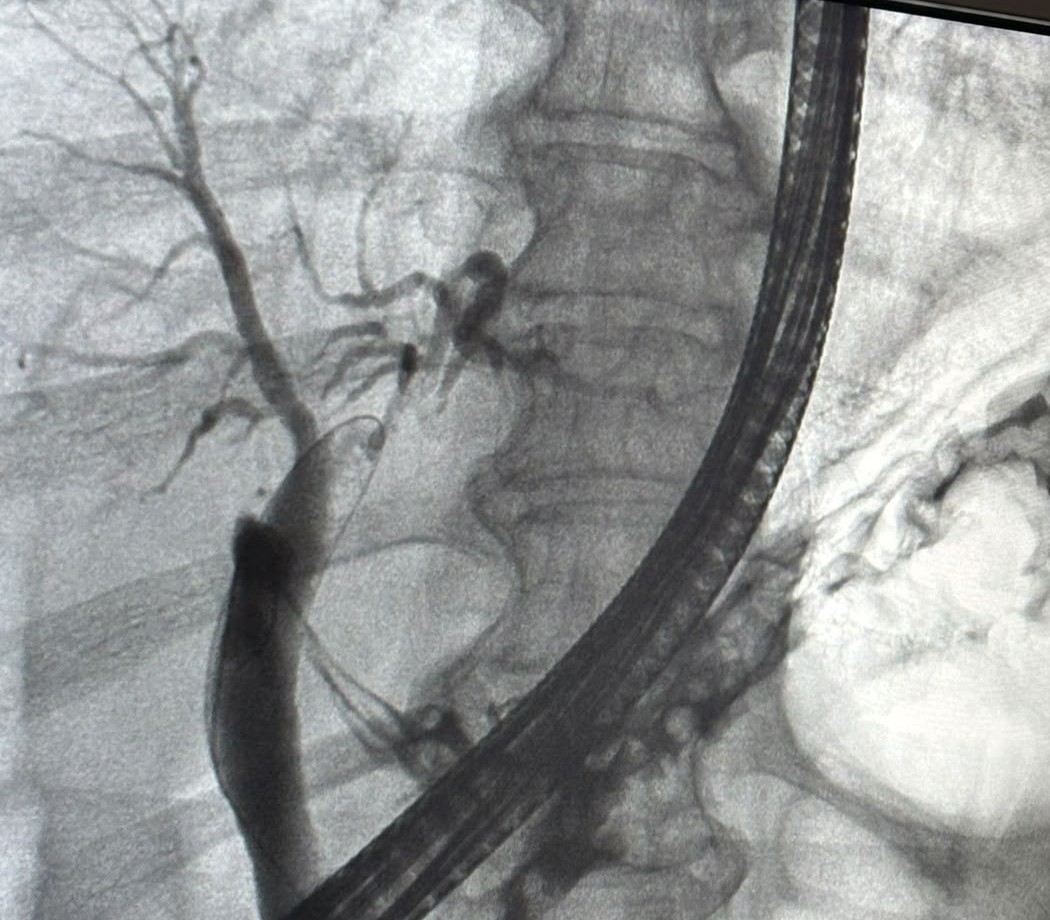
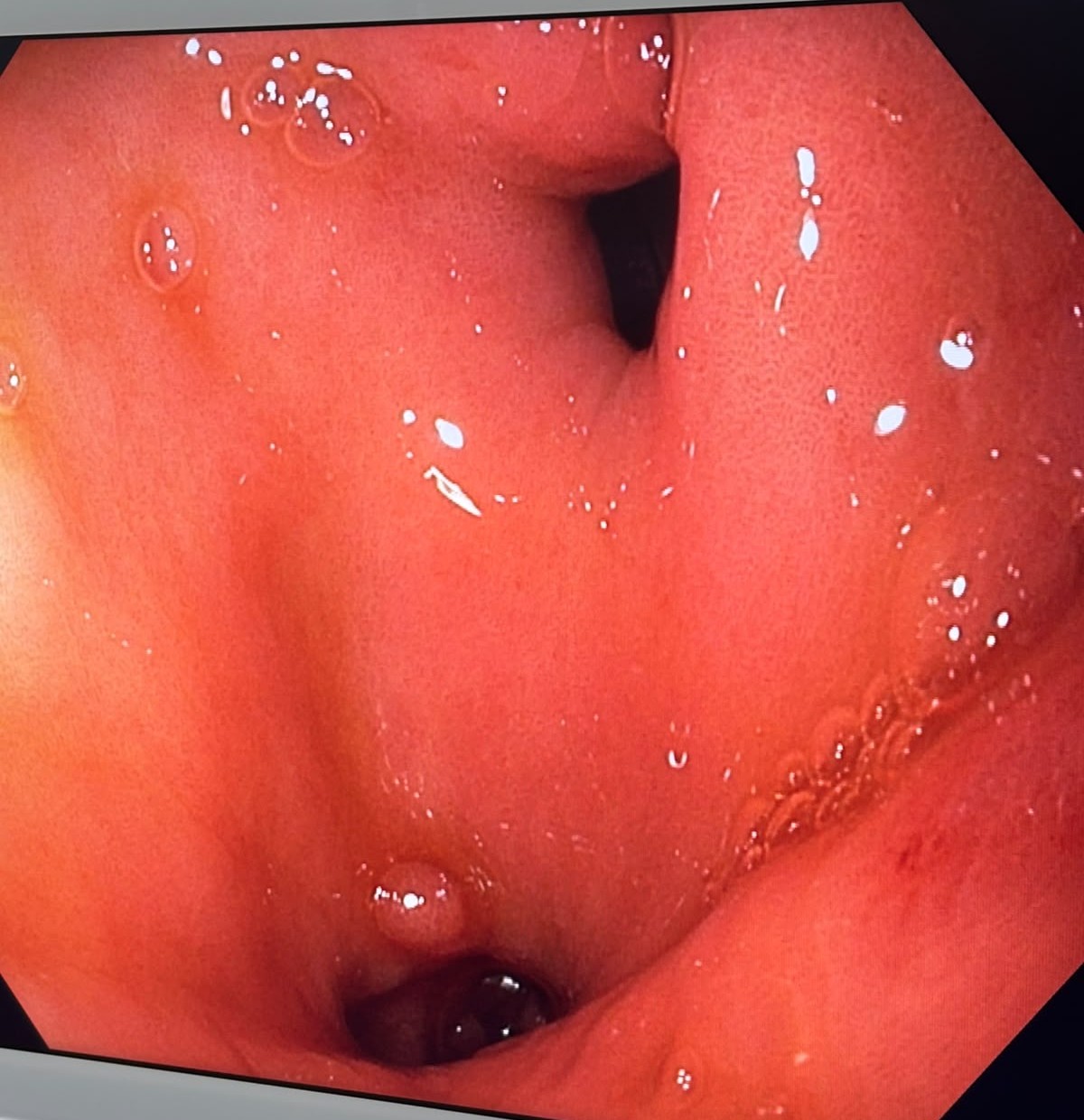
A 70-year-old woman with diabetes and hypertension presented with abdominal pain, a cholestatic lab pattern, and pneumobilia on ultrasound without bile-duct dilation. She had an unclear gastric-ulcer history and no known biliary surgery. EUS confirmed pneumobilia in extrahepatic and some intrahepatic ducts plus steatosis. ERCP with cholangioscopy showed an inflammatory tract. Biopsies were taken.
The working hypotheses were a prior abscess that fistulized to the stomach, or a passed gallstone that left a biliogastric fistula. The gallbladder was collapsed and no surgical clips were seen. A plastic biliary stent was left next to the opening. Closing from the gastric side with APC plus an over-the-scope clip was considered.
If the tract is mature and the patient is not jaundiced or repeatedly infected, observation is reasonable and the surgeon should be told the fistula exists before any cholecystectomy. If food is entering the ducts, close the fistula once malignancy is excluded and papillary outflow is confirmed, or the patient can develop sump syndrome.
Clinical Pearl: Pneumobilia without duct dilation is a fistula until proven otherwise. Do not close a silent mature tract by default. Do close if food is refluxing into the biliary tree and the papilla drains well. If the gallbladder is still in situ after a presumed passed stone, plan cholecystectomy with the fistula mapped.
Quick Consultations
Aug 11 · EGJOO after peptic-stricture dilation
An 85-year-old with bolus obstruction had a peptic stricture the scope could pass. Mean IRP 22 mmHg. DCI was first called normal, then challenged: measure from the transition zone, not from UES to LES. Weak peristalsis and possible distal spasm with a 3 cm hernia. EGJOO and spasm can be secondary to reflux. Take esophageal biopsies to exclude eosinophilic esophagitis. PPI plus a prokinetic is a reasonable first path.
Aug 13-14 · Rising bilirubin after a clean ERCP
Suspected gallstone pancreatitis, bilirubin 4.5, possible sludge on MRCP. Cholangiogram clean, sphincterotomy, nothing retrieved. Next-day bilirubin 6.41 and ALP 222. Fractionate the bilirubin and watch the transaminases. A second ERCP will not help if the problem is pancreatitis, drugs, sepsis, or delayed clearance. This patient's bilirubin later improved without a repeat procedure.
Aug 14 · Uphill versus downhill varices
Proximal esophageal varices are downhill until mediastinal and SVC obstruction are excluded. Uphill (distal) varices still need the usual portal-hypertension workup. Ask about facial swelling and review the mediastinum before labeling the case.
Aug 15-16 · Octreotide for dumping after mini-gastric bypass
Early dumping after mini-gastric bypass. Short-acting octreotide three times daily is a test. If it works, long-acting options are octreotide LAR (intramuscular) or lanreotide (subcutaneous). Cost and whether intramuscular injection actually reaches muscle in an obese patient decide the formulation.
Aug 18-23 · Unconjugated-dominant ALF in shock
A man in his 30s presented GCS 3 in shock, newly HBsAg positive, with a cystogastrostomy for walled-off necrosis three weeks earlier. Bilirubin 10.3 (indirect 7.4), ALT 639, AST 163, INR 13.7, ammonia 450. This is not classic ischemic hepatitis (AST usually exceeds ALT and runs in the thousands). The group offered hemolysis, bleed into the collection with resorption, and massive necrosis that destroys UGT1A1 so unconjugated bilirubin cannot be conjugated. Transplant criteria were already met. He died within 12 hours.
Aug 20 · Stacked covered SEMS that both occluded
Chronic pancreatitis with distal biliary stenosis. A covered metal stent migrated proximal to the stricture. A second stent deployed beside the first. Both occluded. Plastics placed inside. Jaundice returned in two weeks. The remaining endoscopic options are limited; surgery is on the table.
Aug 20 · Uncovered pyloroduodenal stent against the ampulla
Extrinsic metastatic D1 obstruction treated with an uncovered stent. Post-procedure pancreatitis. MRCP suggested the distal end touching the ampulla. If pain and enzymes settle and the patient eats, observe. If not: cannulate through the stent cells, APC the cells on the papilla, or convert to EUS-guided gastrojejunostomy.
Aug 23-24 · Blue rubber bleb lesions on enteroscopy
Melena. Capsule and enteroscopy showed multiple small-bowel lesions consistent with blue rubber bleb nevus syndrome. Named options: surgical resection, endoscopic mucosectomy, clipping, histoacryl, loop-and-let-go, and sirolimus. Confirm the diagnosis before committing to systemic therapy.
Aug 27 · Ileocecal-valve polyp: EMR versus underwater
Healthy 75-year-old. Conventional EMR was the majority choice. Add snare-tip soft coagulation on the edges (one suggested setting: effect 4, 80 W) and clip if bleeding risk is high.
Aug 27 · Post-cricoid web that will not take a scope
Young woman, prior dilation, unable to intubate with a pediatric or standard gastroscope. A soft-tip wire plus fluoroscopy is mandatory. A cap can show a pinhole stenosis. Exclude a Zenker diverticulum. In a young woman, think Plummer-Vinson and biopsy: squamous carcinoma can complicate that syndrome.
Aug 28 · When to dilate a radiation esophageal stricture
PEG-dependent after lung-cancer radiotherapy. At six weeks, a 10 cm stenosis passed only by a transnasal scope. Mucosal injury generally settles 4 to 6 weeks after radiotherapy ends, so dilation can start now or in two more weeks. Prefer bougie and the rule of three once ulcers have settled. Intralesional triamcinolone has weak support for this indication.
Aug 30 · Jejunal capsule erosions, NSAIDs denied
A 28-year-old with migraines, pain, and sporadic diarrhea. Colonoscopy normal. Capsule showed multiple jejunal lesions over three segments. Reads ranged from reparative change and superficial ulceration to mucosal protrusion, not a frank ulcer. NSAIDs were denied. Treat as undecided small-bowel mucosal injury pending more history and, if needed, enteroscopy.
Community Notes
- IBD / oncology: Checkpoint-inhibitor colitis that fails corticosteroids and drug hold has an established next step with anti-TNF (infliximab loading at usual IBD doses, 5 mg/kg, was the in-thread example).
- Technique: Chromoendoscopy dye volumes used in the group: two 5 ml ampoules of 0.8% indigo carmine in 250 ml water, or one 10 ml ampoule of 1% methylene blue in 240 ml water, delivered with a spray catheter.
- Technique: Peutz-Jeghers polypectomy: inject a small saline cushion at the base, then blend or pure cut. Do not use pure cut without a cushion. Thin stalks can take coagulation current.
- Dilation: Intralesional steroid has some support for Crohn strictures to reduce repeat dilation. It is a poor fit for radiation esophageal strictures.
- Colon: Rectal fecaloma: Coca-Cola instillation was the practical answer. Also ask why a 44-year-old has a fecaloma (pelvic-floor dysfunction, Hirschsprung, or habit).
What’s Next
Every case in this digest came from real conversations in the EndoCollab private WhatsApp community, 650+ practicing endoscopists discussing cases daily from every continent. Lifetime members get permanent access to the group, plus the full EndoCollab case library.