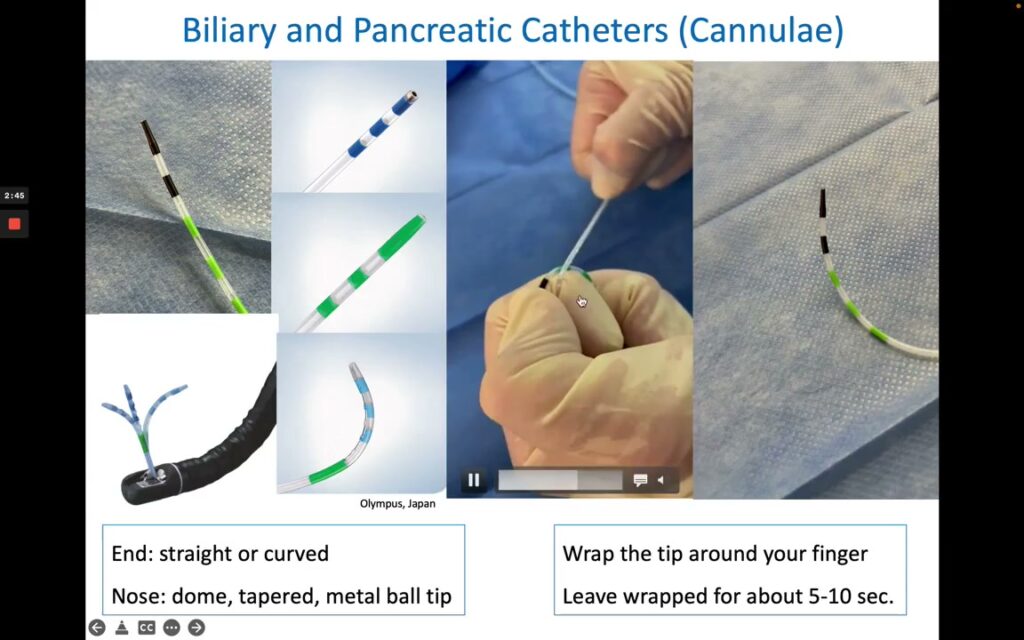
You are performing an ERCP and the papilla sits inside a periampullary diverticulum, partially hidden and angled away from you. Your standard sphincterotome cannot engage the orifice. A tapered-tip catheter is the right tool, but even that comes out straight and misses the angle. What if you could shape the catheter to match the anatomy in seconds?
Why Standard Devices Fall Short
Papillae come in a wide range of shapes and orientations. The Haraldson classification captures some of this variability, but it does not account for diverticula or surgically altered anatomy such as Billroth II. When a papilla has a pinhole opening, sits deep inside a diverticulum, or faces an unusual direction, a standard sphincterotome with a dome-shaped nose may not reach the biliary orifice.
Tapered-tip catheters solve part of the problem : their fine point can find a pinhole opening where a dome tip cannot. But they ship straight, and many of these challenging papillae also require the curved approach angle that a sphincterotome provides. Commercial pre-curved catheters exist but are not always available in the procedure room when you need them.
Continue reading with a membership
Watch the full 3-minute technique demonstration with English captions and step-by-step instruction.
Plus the full video with English captions.
Already a member? Log in