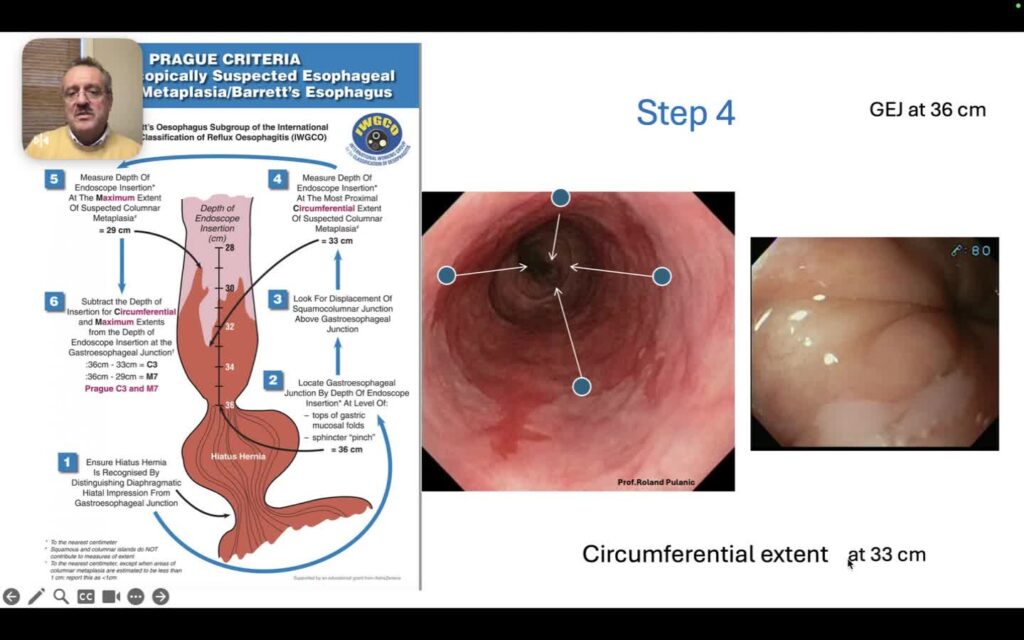
Prague C and M classification for Barrett’s esophagus: hiatal hernia, GE junction landmarks, measuring circumferential and maximal extent, plus Seattle.
Barrett’s esophagus varies from single tongues of columnar epithelium to long circumferential segments, so a shared measurement language is essential. This lecture teaches the Prague C and M classification step by step: document hiatal hernia on antegrade and retroflexed views, avoid mistaking pseudo-folds for true gastric folds, and locate the GE junction using the top of the gastric folds plus palisade veins (Kyoto landmark). You then measure circumferential (C) and maximal (M) extents from the GE junction at the incisors, with worked examples such as C3 M4 and C2 M6. The session links Prague length to biopsy strategy, favoring the Seattle protocol (start at or just above the GE junction, four-quadrant every 2 cm, separate jars) over starting deep in cardia when the goal is esophageal sampling. Clinical pearls emphasize that dysplasia is enriched proximally and on the right side of the esophagus (about 12 to 4 o’clock), so send enough tissue and add targeted bottles for any suspicious mucosa.
Continue with EndoCollab membership.
Get this lecture, the rest of this course, and the full EndoCollab library.
Course: Barrett’s Esophagus · Browse all lessons in Barrett’s Esophagus
Continue reading with a membership
Get access to the full content, course videos, case library, and our private WhatsApp community.
Already a member? Log in
We protect your privacy. No spam. Unsubscribe anytime.