TECHNIQUE ARTICLE
Abstract
Background: Nasojejunal (NJ) feeding tube placement is challenging in patients with pyloric or duodenal stenosis, where advancing a standard gastroscope alongside a tube is not feasible.
Case and Technique: We describe a step-by-step technique for guidewire-assisted NJ tube insertion using an ultraslim transnasal endoscope, a long 0.035-inch biliary guidewire, and fluoroscopic confirmation of tube position. This approach was successfully applied in a 60-year-old female with gastric outlet obstruction due to chronic calcific pancreatitis.
Conclusion: Ultraslim transnasal endoscopy with biliary guidewire exchange and fluoroscopic guidance is a safe and effective strategy for NJ tube placement in patients with stenotic pylorus or duodenum. Key technical pearls — including guidewire looping strategy, gastric decompression during scope withdrawal, tube lubrication with olive oil, and countertraction mechanics — are highlighted.
Keywords: nasojejunal feeding tube; NJ tube; ultraslim endoscope; transnasal endoscopy; biliary guidewire; fluoroscopy; gastric outlet obstruction; enteral access
★ Key Clinical Takeaways
- Ultraslim transnasal endoscopy enables NJ tube placement even through tight pyloric or duodenal strictures impassable with a standard gastroscope.
- Maximizing guidewire length in the jejunum (looping is acceptable) is critical to maintaining purchase during tube advancement.
- Gastric decompression during scope withdrawal and inner-lumen lubrication with olive oil significantly reduce tube advancement resistance.
- Fluoroscopic contrast confirmation is mandatory to verify jejunal position past the ligament of Treitz before initiating feeds.
Case Presentation
Placement of nasojejunal feeding tubes may be complicated and cumbersome. There are many nasojejunal tubes available including Dobhoff tube, Kangaroo feeding tube, Cook NJFT, and others. Often the tube is placed orally and then advanced endoscopically (e.g. UAB Raptor technique). This technique is useful if a regular gastroscope can be advanced with the tube passing the second portion of the duodenum. However, any tube placed orally needs to be transferred to the nostril of the nose after the procedure is done. In addition, if patients have a stenotic pylorus or duodenum, passing a scope with tube is impossible. In this situation, using an ultraslim scope is a great option.
A 60-year-old female patient with stenotic duodenum due to chronic calcific pancreatitis and gastric outlet obstruction required nasojejunal feeding tube. Herein we present the key steps to place a nasojejunal feeding tube using an ultraslim scope (transnasal endoscopy) with guidewire placement into jejunum and fluoroscopy-assisted deployment of the feeding tube.
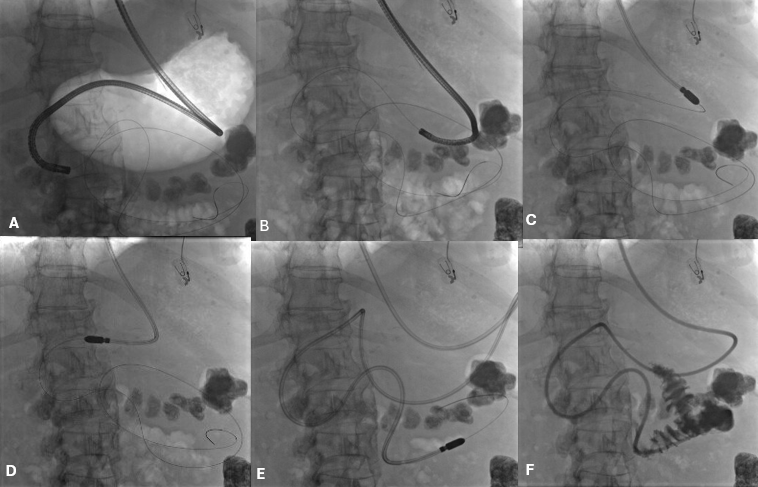
Technique
- Perform transnasal endoscopy with ultraslim scope.
- Advance scope through pyloric and duodenal bulb stricture into the third portion of the duodenum.
- Advance a long 0.035-inch biliary guidewire (e.g., Jagwire, or 0.025-inch Olympus Visiglide) through the scope into the jejunum.
Tip: Advance as much wire as possible — looping is acceptable. The extra wire length facilitates pull-and-straighten maneuvers while advancing the feeding tube. - Remove scope, leaving wire in jejunum.
Tip: Always suction all air out of the stomach during scope retrieval. It is easier to advance a tube through a collapsed stomach. If the stomach is distended, looping may complicate tube advancement. - Advance feeding tube over the wire through the nose.
Tip: Lubricate the inner lumen of the tube with olive oil (5–10 mL) so it advances smoothly over the wire. Apply lubricating gel to the outer tube surface when introducing it through the nostril. - While pushing the tube, gently pull on the wire (countertraction).
- Inject water-soluble contrast through the tube to confirm excellent position in the proximal jejunum, past the ligament of Treitz.
Tip: Always flush with water after contrast injection to remove residual stickiness and prevent tube clogging.
List of Abbreviations
NJ: nasojejunal; eFTR: endoscopic full-thickness resection; UAB: University of Alabama at Birmingham; NJFT: nasojejunal feeding tube
References
- Brandt CP, Mittendorf EA. Endoscopic placement of nasojejunal feeding tubes in ICU patients. Surg Endosc. 1999 Dec;13(12):1211–4. doi: 10.1007/pl00009623. PMID: 10594268.
- Martínez-Alcalá A, Mönkemüller K. The University of Alabama at Birmingham (UAB) Raptor method for direct percutaneous endoscopic gastrostomy with jejunal extension tube placement. Endoscopy. 2022 Mar;54(3):E96–E97. doi: 10.1055/a-1388-5247. Epub 2021 Mar 30. PMID: 33784754.