
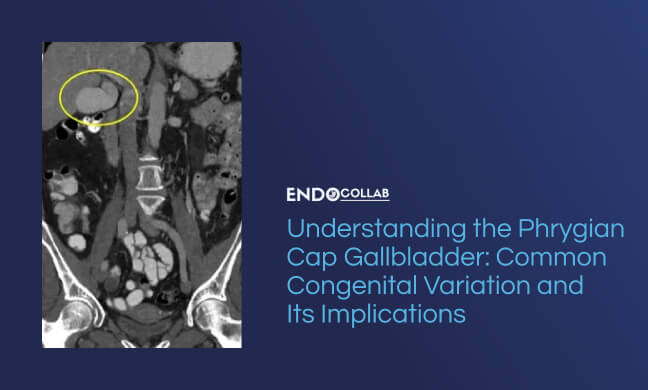
A Phrygian cap gallbladder is a congenital fold of the gallbladder fundus. It shows up in about 4% of people, can look like a liver mass on imaging, and is not a disease. Treat only if it produces biliary symptoms. See also the TPE case note on Phrygian cap gallbladder.
What is a Phrygian cap gallbladder?
A congenital abnormality of the gallbladder, found in 4% of the population. The gallbladder is a pear-shaped organ located beneath the liver. Variations can occur in form, location, or number. The Phrygian cap is the most common of those anomalies.
Can a Phrygian cap look like a liver mass?
On imaging it can mimic a liver mass, leading to potential misinterpretation. Despite the unusual appearance, it is not considered pathological and typically does not cause symptoms.
Does a Phrygian cap gallbladder need treatment?
Not by itself. It is not a disease or a harmful condition. Surgical intervention is unnecessary unless it results in symptoms such as biliary colic or cholecystitis.
Phrygian cap gallbladder at a glance
- What is it? A congenital abnormality of the gallbladder.
- Incidence: Found in 4% of the population.
- Appearance on imaging: Can mimic a liver mass, leading to potential misinterpretation.
- Pathological significance: None. It is not a disease or a harmful condition.
- Symptoms: Typically none. If it causes biliary colic or cholecystitis, medical intervention might be needed.
- Location: The gallbladder is a pear-shaped organ located beneath the liver.
- Other gallbladder anomalies: Variations can occur in form, location, or number.
FAQ
What is a Phrygian cap gallbladder? A congenital fold of the gallbladder, present in about 4% of people.
Does it need treatment? Not by itself. It is not a disease. Intervene if it causes biliary colic or cholecystitis.

4 Responses
Appreciation to my father who told me regarding this website,
this blog is genuinely awesome.
Thanks very interesting blog!
click over here magazin online md https://internet-magazin.pages.dev/
Nieuwe pornosites brengen innovatieve inhoud voor
volwassen entertainment. Ontdek gegarandeerde porno hubs voor een moderne
ervaring.
Visit my homepage Porrfilmer på svenska