Ingested foreign bodies and food impactions are a common problem in GI endoscopy, and endoscopy is a primary diagnostic and therapeutic tool. Every endoscopist will be called to manage one — and management comes down to three questions: what the object is, where it sits, and how long it has been there. Sharp and pointed objects need emergency removal, magnets need urgent removal within 6 to 12 hours, and only selected coins and other blunt objects fall into the non-urgent category.
This guide summarizes the planning framework from Part 1 of the “From My Toolbox” lecture on foreign body management: timing, imaging, the five-element emergency tray, and the technique principles that keep a sharp-object extraction from becoming a perforation.
When does a swallowed foreign body need emergency endoscopy?
- Emergency: most sharp or pointed objects (needles, pins, sharp-edged bones). A sharp object that has dwelled may already have caused an abscess, a perforation, or bleeding from vessel penetration — late presenters need extra vigilance.
- Urgent (within 6–12 hours): magnets, because they can corrode principally the stomach and the esophagus.
- Non-urgent: mainly some coins and selected other objects. Guidelines allow waiting up to 24 hours for specific object sizes.
A caution from practice: the guideline evidence base is largely low-quality — reviews, few observational studies, almost no prospective trials. Even objects at the guideline sizes have passed the pylorus, turned up in the jejunum, and caused problems — and objects of 2.5 cm have been seen to pass the pylorus quickly. Use the guidelines as a frame, but weigh your own experience, your peers’, and your hospital’s capabilities.
Half of patients present within an hour of ingestion; many arrive later. Ask precisely when symptoms began — dysphagia, inability to handle secretions, and (in children who swallowed coins) similar presentations. On exam, check for crepitus and examine the chest and abdominal wall, especially after sharp-object ingestion.
What imaging should you order before endoscopy?
- Plain X-ray (AP and lateral views): quick and useful for metal objects, coins, and batteries — it gives you the road map for the endoscopy.
- CT: sometimes the safest approach for sharp objects, fish or meat bones, and any impaction near major vessels. In reported cases of foreign bodies penetrating the aorta, the object was removed surgically only after an aortic endograft was placed — pulling blind at endoscopy could have been fatal.
- Barium studies: not recommended. In a food bolus they complicate the situation, and the patient may aspirate and develop pneumonia.
Radiology is not mandatory in every case — endoscopy both diagnoses and treats — but for metal, sharp objects, and suspected complications it changes the plan.
What belongs in the foreign-body tray?
Keep a dedicated foreign-body box in the emergency cart. Five elements cover almost every extraction:
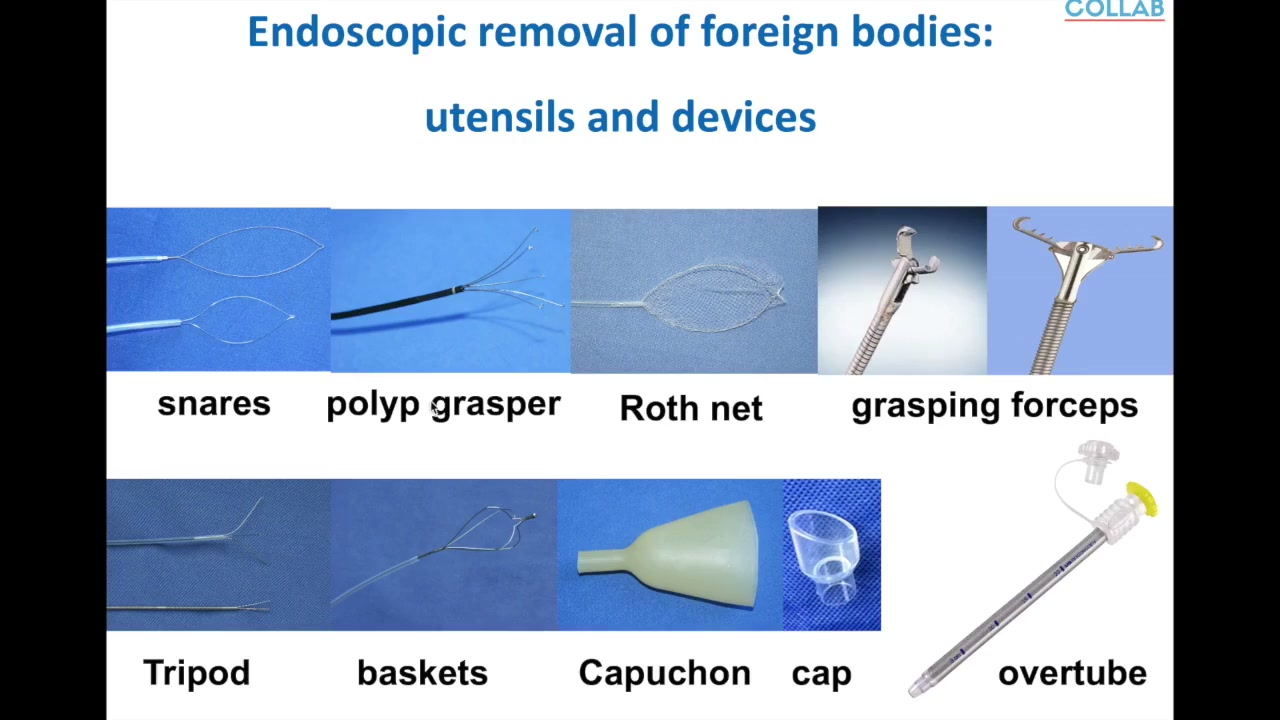
- Snare — include a hexagonal snare; the “polyp grasper” earns its name but works here too.
- Overtube — different lengths for esophagus, stomach, and colon; balloon-enteroscopy overtubes extend the reach into the small bowel.
- Cap or capuchon — the hood on the endoscope tip that shields the mucosa. A capuchon can even be improvised from a plain glove (shown by Dr. Alvaro Martínez-Alcalá in the EndoCollab innovation section).
- Net — Roth net or similar (octopus net in Germany). Hexagonal-frame nets keep their opening memory after repeated use.
- Toothed grasping forceps — rat-tooth, alligator, raptor: have at least one; a mini rat-tooth is worth adding.
Basket caveat: check the sheath diameter before stocking a basket. Many are designed for ERCP and run 2.9–3.0 mm — they will not pass a 2.8 mm gastroscope channel.
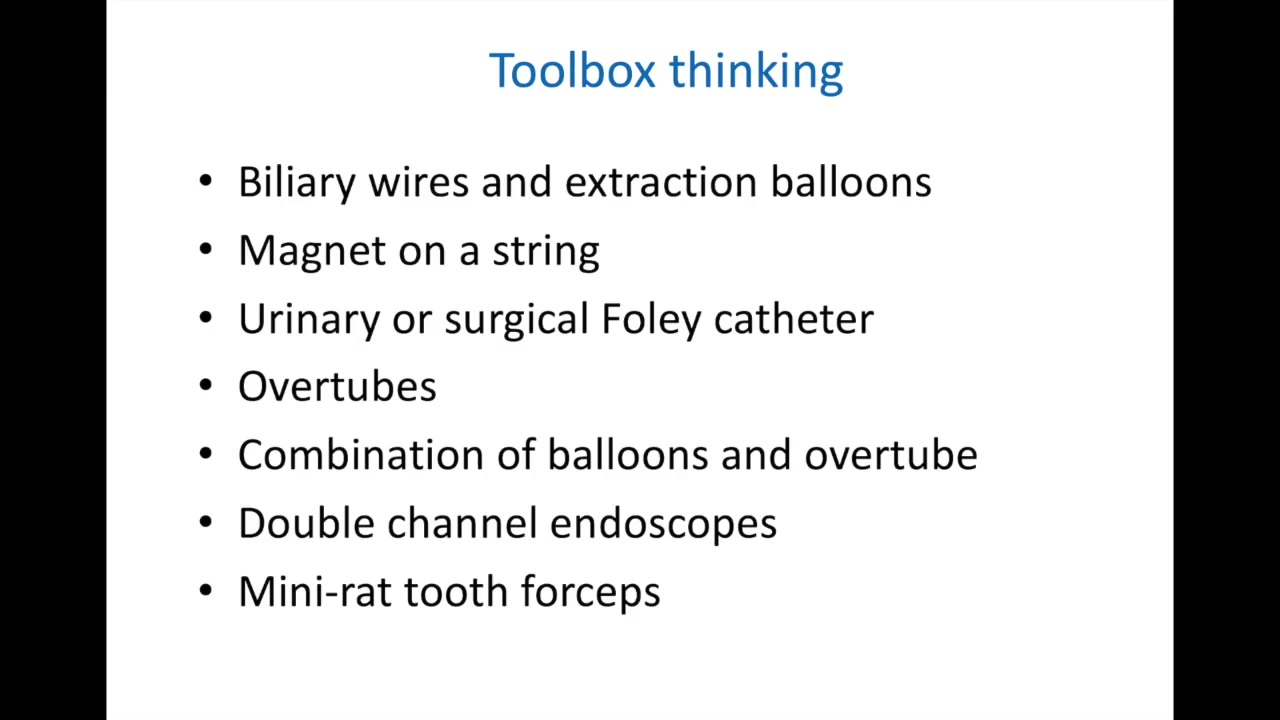
Beyond the five elements, think “toolbox”: a wire can be useful, extraction balloons have a role, a magnet on a string helps retrieve magnets, and an extra forceps — the mini rat-tooth — earns its slot. The lecture’s “toolbox thinking” slide lists further options, including Foley catheters, balloon-overtube combinations, and double-channel endoscopes.
How do you remove a sharp object without tearing the lumen?
The principles repeat across every case in the lecture — a metal object embedded in the duodenal bulb, needles in the duodenum and small bowel, a pin retrieved from the trachea by bronchoscopy, a toothpick removed from the small bowel:
- Plan before you pull. Look at the object and align its axis with the axis of the GI lumen so extraction follows the anatomy.
- Clear the field. Suction bile and fluid before grasping — a fundus full of bile cost visibility mid-extraction in one of the cases shown.
- Disembed, don’t yank. Grasp firmly, then free the stuck end with gentle torquing movements of the endoscope.
- Control the sharp end. Grasp so the sharp tip trails during withdrawal, and protect the wall with an overtube or cap. Inside the overtube, the mucosa cannot be damaged.
- Insufflate to dilate. Extra air or CO2 widens the lumen so the sharp tip has less chance of touching the wall; go back at the end and desufflate.
- Bend what will not fit. A long needle that could not be drawn fully into the overtube was bent into a boomerang shape so the sharp end pointed away from the mucosa during withdrawal.
- Re-inspect and finish. Look at the impaction site afterward; in the duodenal case a clip was placed at the site even though no large perforation was seen.
An overtube also lets you re-enter repeatedly — in one anastomotic-abscess case, 50 back-and-forth endoscopies cleared all the food and debris safely.
When should surgery be on standby?
Foreign body removal is not always endoscopically feasible, and complications — perforation, obstruction, penetration into vessels — must be anticipated. Involve the surgeon early when the object is sharp, when imaging shows impaction near a vessel, or when the patient presents late. The airway decision deserves the same judgment: intubation protects a patient who cannot handle secretions or has a proximal esophageal foreign body, but tube compression can make esophageal extraction harder, and light sedation with a cooperative, awake patient is sometimes the safer choice. This is a case-by-case decision built on your team’s experience.
Download the Foreign-Body Tray Checklist
A print-ready reference card: the five-element emergency tray and the sharp-object extraction protocol, ready to save or print for your unit.
Frequently asked questions
Do most swallowed foreign bodies pass on their own?
The literature says most do — but that figure deserves skepticism, and it applies to small, round, blunt objects. Identify the object first; sharp objects and magnets are never “wait and see,” and for coins and batteries a quick X-ray helps plan the endoscopy.
Should glucagon be used for food bolus impaction?
Some emergency physicians use it. The practice described in this lecture skips glucagon in favor of prompt endoscopy, which treats the impaction and finds the underlying cause — often a peptic stricture, eosinophilic esophagitis, or a tumor first revealed by the impaction.
Who is most at risk of foreign body ingestion?
Children (mostly coins, unintentional), middle-aged adults (fish bones, food bolus), and adults over 60 (dental prostheses). Add occupational habits (nails held in the mouth by roofers and carpenters), intentional ingestion in psychiatric illness and incarceration, and iatrogenic objects such as migrated stents.
Does every extraction need endotracheal intubation?
No. It is a balance: secretion handling problems and proximal esophageal objects favor intubation; otherwise light sedation may give a more cooperative patient with less aspiration risk.
Watch the full lecture
Every case above on video: the duodenal metal object, the needle extractions, the trachea pin, and the full device walkthrough.