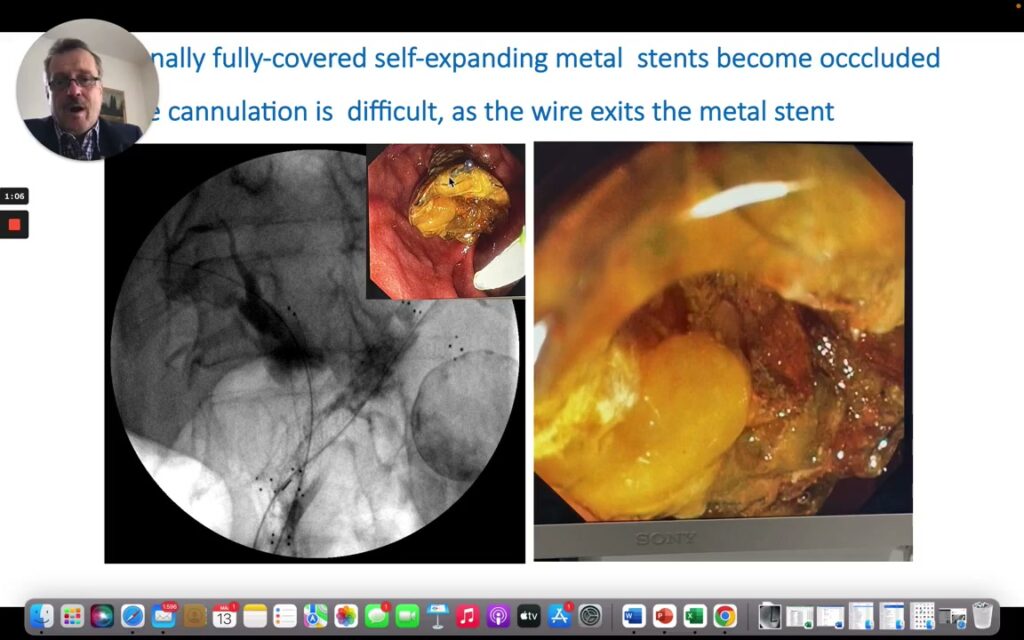
You place a self-expanding metal stent for a malignant bile duct stricture. Months later the patient is still alive, the stent is occluded, and every straight wire you pass wants to exit through the uncovered mesh. That is when the U-wire, or flipped wire tip technique, belongs in your ERCP plan.
Why the Straight Wire Fails
Patients with one or more SEMS for malignant biliary strictures are surviving longer with modern chemotherapy. Occlusion becomes more common after six to nine months. Recannulating those stents can be hard because a straight wire tip often slips out through the non-covered portions of the metal mesh. Once the wire is outside the lumen you want, placing a second metal or plastic stent becomes unreliable.
The same failure mode shows up in other tight or branched paths: a pancreatic stent with side holes, pancreatic side branches, and a cystic duct stump after cholecystectomy. The tip finds the wrong opening first.
Continue reading with a membership
Get access to the full content, course videos, case library, and our private WhatsApp community.
Already a member? Log in
We protect your privacy. No spam. Unsubscribe anytime.