Case Report

 Susan Feldman, MD and Klaus Mönkemüller, MD, PhD, FASGE, FESGE, FJGES
Department of Gastroenterology, Carilion Clinic / Virginia Tech Carilion School of Medicine, Roanoke, VA, USA
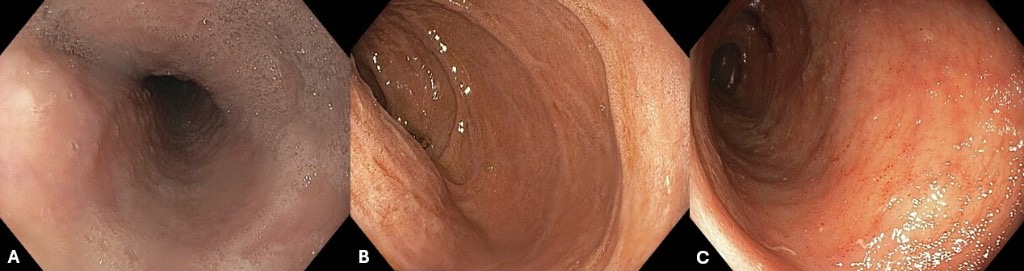
Figure 1 · Endoscopic findings


Experienced teaching points
Clinical Pearls
01Systemic sclerosis commonly affects the gastrointestinal tract through collagen deposition and muscular atrophy.
02Endoscopic evaluation may reveal esophageal dysmotility with dilation, megaduodenum, and mega ileum.
03Dilated bowel segments can delay transit and predispose to secondary bacterial overgrowth.
04Recognizing these patterns is essential for comprehensive management of scleroderma-related GI disease.
Get cases like this every other Saturday. Free on The Practicing Endoscopist.
Final Diagnosis
Esophageal motility disorder, mega duodenum, and mega ileum associated with systemic sclerosis.
Clinical History
A 48-year-old woman with known systemic sclerosis was referred for malignancy screening. She reported dyspepsia and abdominal bloating. Her medications included mycophenolate mofetil. On clinical examination, her abdomen was slightly distended and tympanitic but non-tender. The indication for endoscopy was malignancy screening and evaluation of her gastrointestinal symptoms.
Endoscopic Findings
- Esophageal motility disorder and dilation with retained saliva.
- Markedly dilated duodenum with wide separation between Kerckring folds.
- Markedly dilated terminal ileum on colonoscopy.
Endoscopic Technique
Standard esophagogastroduodenoscopy and colonoscopy with terminal ileum intubation were performed for malignancy screening and symptom evaluation. No therapeutic intervention was required during this diagnostic examination.
Discussion
Mechanism. Systemic sclerosis, or scleroderma, is characterized by widespread collagen deposition, resulting in tissue and organ fibrosis. Most patients experience gastrointestinal manifestations, including esophageal dysmotility, gastroparesis, megaduodenum, small bowel diverticulosis, and chronic intestinal pseudo-obstruction. The gastrointestinal abnormalities are likely a consequence of muscular atrophy and collagen replacement of the outer longitudinal layer relative to the inner circular layer. Small intestinal involvement can lead to delayed transit, dilation of small bowel loops, and secondary bacterial overgrowth.
What the scope shows. In this patient, the endoscopic triad of esophageal dilation with retained secretions, megaduodenum, and mega ileum illustrates how scleroderma can remodel multiple GI segments at once.
Why it matters. Recognition matters because these findings explain common symptoms such as dyspepsia and bloating, and they raise the possibility of bacterial overgrowth when dilated loops impair clearance.
References
- Prakash R, Saxena A. Gastrointestinal manifestations of systemic sclerosis. Gastroenterol Res Pract. 2017;2017:7102157.
- Runchey S, Sharma A. Esophageal dysmotility in systemic sclerosis: A review. J Clin Gastroenterol. 2021;55(8):666-673.
- Abu-Amara M, et al. Small bowel involvement in systemic sclerosis: Clinical and endoscopic features. World J Gastroenterol. 2011;17(30):3594-3599.
- Hokama A. Megaduodenum in systemic sclerosis. Rheumatology. 2022;61:e194.
For your teaching file
Save this case as a PDF
Opens the companion page on The Practicing Endoscopist.