CASE REPORT
Gastrointestinal stromal tumors (GIST) are mesenchymal neoplasms arising from the cells of Cajal. While most GISTs are gastric, 30% occur in the small bowel and tend to be more aggressive, with a 5-year survival rate of 25%.
Abstract
Background: Gastrointestinal stromal tumors (GIST) are mesenchymal neoplasms arising from the cells of Cajal. While most GISTs are gastric, 30% occur in the small bowel and tend to be more aggressive, with a 5-year survival rate of 25%.
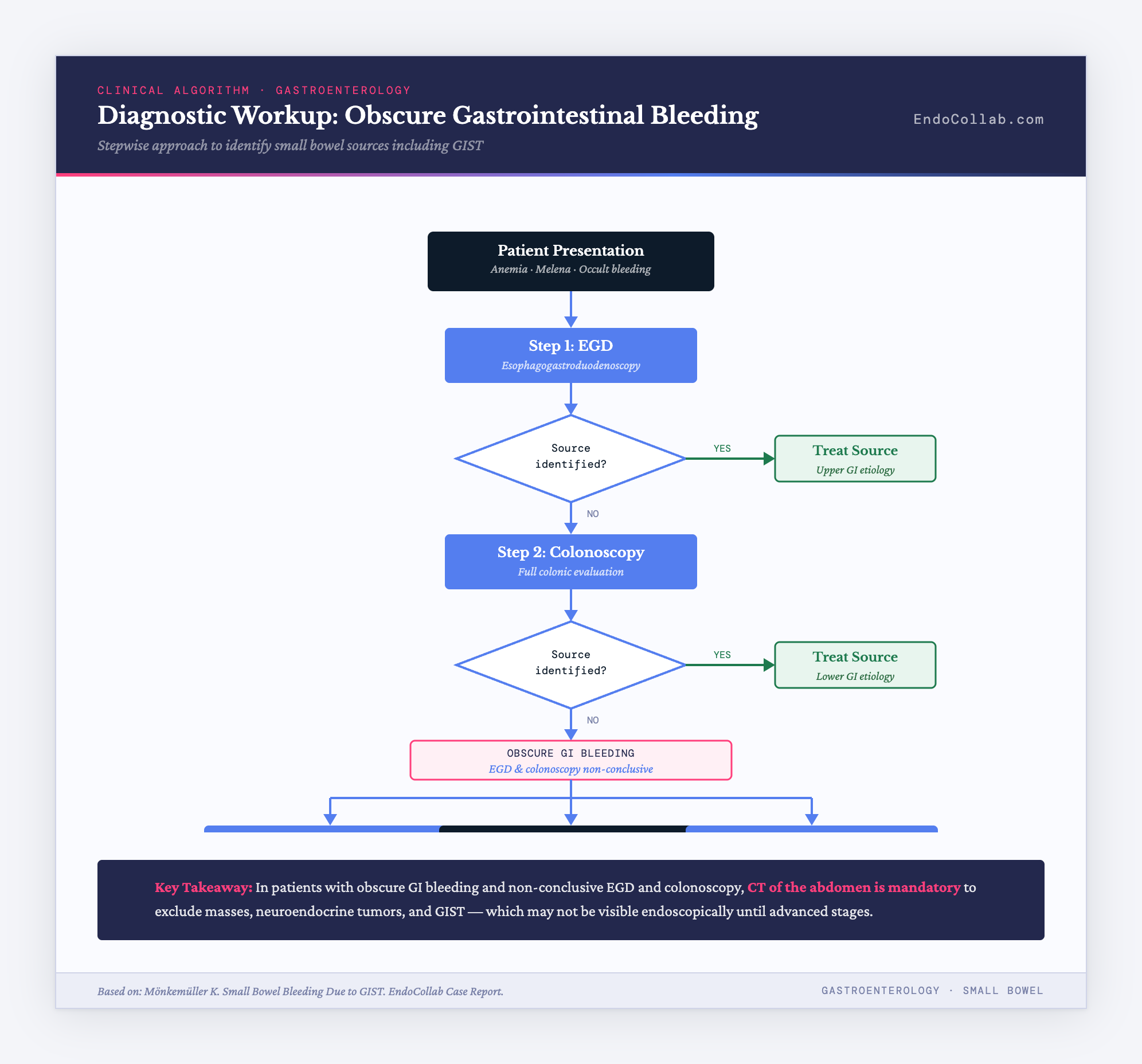
Case: A 57-year-old male with diabetes mellitus, chronic kidney disease, iron deficiency anemia, and melanoma presented with recurrent anemia and melena. Initial EGD and colonoscopy were unrevealing. Capsule endoscopy identified a bleeding lesion in the ileum, and CT revealed a large pelvic mass. CT-guided biopsy confirmed an epithelioid gastrointestinal stromal tumor classified as G3M3.
Conclusion: In patients with obscure gastrointestinal bleeding and non-conclusive endoscopic examinations, computed tomography of the abdomen is essential to exclude masses, cancers, neuroendocrine tumors, and GIST.
Keywords: gastrointestinal stromal tumor; GIST; small bowel bleeding; capsule endoscopy; obscure gastrointestinal bleeding; deep enteroscopy; mesenchymal neoplasm
★ Key Clinical Takeaways
- Small-bowel GISTs account for 30% of all GISTs and tend to be more aggressive with worse prognosis than gastric GISTs.
- Patients with GIST commonly present with obscure gastrointestinal bleeding resulting from surface ulceration and necrosis.
- When EGD and colonoscopy are non-conclusive, capsule endoscopy and deep enteroscopy are valuable tools for identifying small bowel lesions.
- Computed tomography of the abdomen should always be obtained to exclude masses, cancers, neuroendocrine tumors (carcinoid), and GIST in patients with obscure GI bleeding.
Case Presentation
A 57-year-old male with history of diabetes mellitus, chronic kidney disease, iron deficiency anemia, and melanoma presented with recurrent anemia and melena. One year prior he had a similar episode of bleeding, with drop of hemoglobin to 6 gr/dl. At that time EGD and colonoscopy were unrevealing, except for erosive gastritis and colon diverticulosis. One year later he presented himself again with melena and drop in hemoglobin. EGD and colonoscopy were unrevealing. Capsule endoscopy showed a bleeding lesion in the ileum (Figure 1).
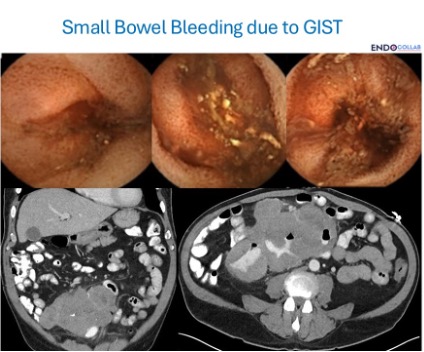
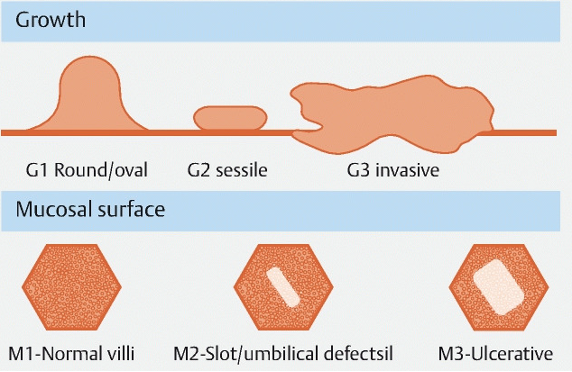
Single balloon enteroscopy was negative, however only part of the terminal ileum could be visualized. CT of the abdomen showed a huge pelvic mass originating or infiltrating the small bowel. This tumor was G3M3 based on the classification by Martinez-Alcala et al. Percutaneous, CT guided biopsy revealed an epithelioid gastrointestinal stromal tumor.
Classification of Small Bowel GIST
Gastrointestinal stromal tumors (GIST) are mesenchymal neoplasms that arise from the cells of Cajal in the gastrointestinal tract. While most GISTs are located in the stomach, 30% of GISTs are found in the small bowel. Small-bowel GISTs tend to be more aggressive and have worse prognosis with a 5-year survival rate of 25%. Therefore, an early diagnosis is mandatory.
Patients with GIST usually present with obscure gastrointestinal bleeding, which results from surface ulceration and necrosis. Other complications of GISTs include bowel obstruction, intussusception, and tumor perforation. The diagnosis of small bowel GIST can be very difficult. Because of its non-specific initial symptoms, patients are often diagnosed with a small bowel GIST only in advanced, metastasized stages of the disease, when curative therapeutic option is not possible.
Key Takeaway: Whenever investigating patients with obscure gastrointestinal bleeding and non-conclusive endoscopic examinations such as EGD and colonoscopy, deep enteroscopy and capsule endoscopy, it is important to obtain a computed tomography of the abdomen to exclude masses, cancers, neuroendocrine tumors (carcinoid) and GIST, such as in this case.
References
- Martinez-Alcalá A, Fry LC, Kröner T, Peter S, Contreras C, Mönkemüller K. Endoscopic spectrum and practical classification of small bowel gastrointestinal stromal tumors (GISTs) detected during double-balloon enteroscopy. Endosc Int Open. 2021 Apr;9(4):E507-E512.
- Mullady DK, Tan BR. A multidisciplinary approach to the diagnosis and treatment of gastrointestinal stromal tumor. J Clin Gastroenterol. 2013;47:578–585.
- Almeida N, Figueiredo P, Lopes S et al. Double-balloon enteroscopy and small bowel tumors: a South-European single-center experience. Dig Dis Sci. 2009;54:1520–1524.
- Akyüz U, Erzin Y, Cengiz C. Diagnosis of gastrointestinal stromal tumors with double-balloon enteroscopy. Turk J Gastroenterol. 2010;21:39–41.