Case Report


 Susan Feldman, MD; Rami Musallam, MD; Alexandru Coseru, MD; Paul Yeaton, MD; Klaus Mönkemüller, MD, PhD
Department of Gastroenterology, Virginia Tech Carilion School of Medicine, Roanoke, Virginia, USA
Final Diagnosis
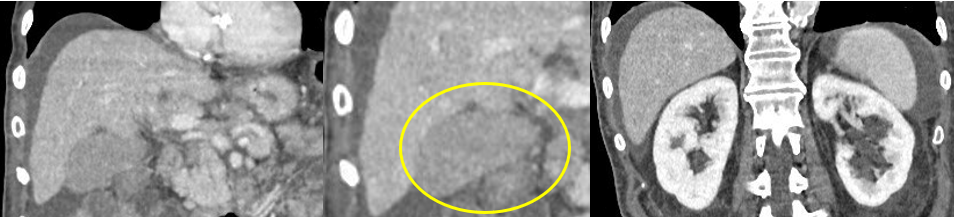
Vicarious excretion of iodinated contrast through the gallbladder was observed on computed tomography imaging.
Figure 1 · Hyperdense gallbladder on coronal CT

Patient Demographics
A 65-year-old male.
Clinical History
The patient underwent a computed tomography (CT) scan to evaluate a suspected pancreatic lesion.
Discussion
- Vicarious excretion refers to the elimination of contrast material via a secondary pathway when the primary excretory route is compromised or overwhelmed.
- Iodinated CT contrast is primarily excreted by the kidneys (approximately 95%), with the liver normally handling a minor proportion (2-5%).
- When renal function is impaired, or in cases of a very high contrast load even with normal renal function, the liver can increase its excretion of contrast into the bile, leading to its concentration in the gallbladder.
- This phenomenon results in the gallbladder appearing hyperdense on late-phase CT images.
- While commonly associated with renal dysfunction, vicarious excretion of contrast through the gallbladder can also be observed in patients with normal renal function.
Key Learning Points
01Vicarious excretion of CT contrast through the gallbladder indicates an alternative excretory pathway, often due to renal impairment or high contrast load.
02The liver plays a compensatory role in contrast excretion when the renal route is overwhelmed.
03A hyperdense gallbladder on CT should prompt consideration of vicarious contrast excretion.
04This finding can occur even in patients with normal kidney function.
05Recognizing this phenomenon avoids misinterpretation of imaging findings.
For your teaching file
Save this case as a PDF
Opens the companion page on The Practicing Endoscopist.