Klaus Mönkemüller, MD, PhD, FASGE, FJGES
Professor of Medicine, Virginia Tech Carilion School of Medicine, Roanoke, Virginia, USA
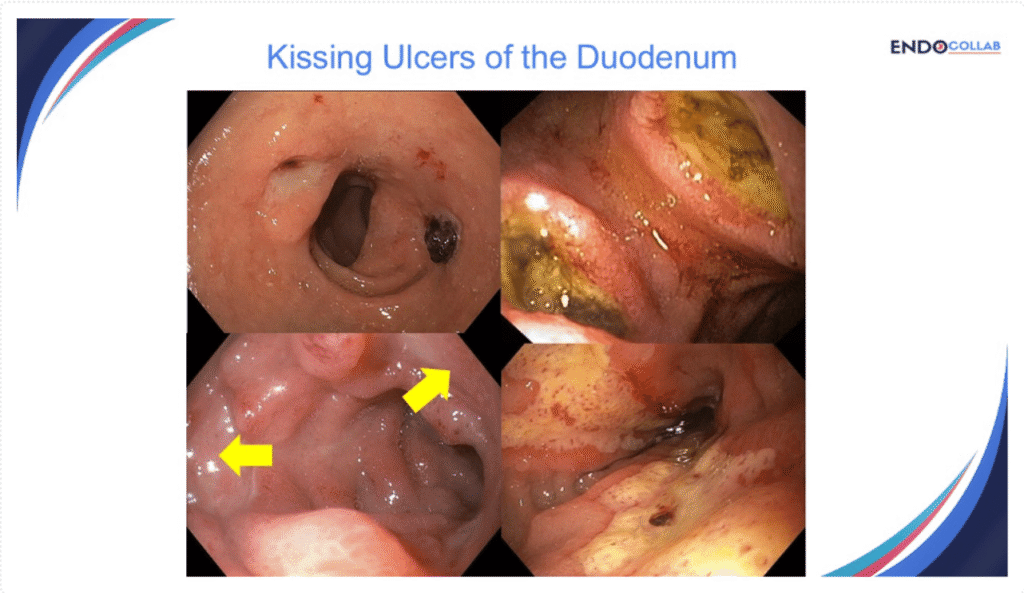
The term “kissing ulcers” of the duodenum describes the presence of two different ulcers facing each other, usually one located anteriorly and the other posteriorly. It appears that the original description was in the surgical literature by Stabile et al in 1979 (Arch Surg). The photo shows a spectrum of kissing ulcers. Occasionally, these may be hard to see (Panel C, yellow arrows).

Multiple duodenal ulcers are a “red flag” and should always intrigue the endoscopist to think of: use of NSAIDs, Zollinger-Ellison syndrome, ischemia, vasculitis, Crohn’s disease, Bechet’s disease, lymphoma, and in immunocompromised or transplant patients think cytomegalovirus, GVHD.
This citation is from the paper by Stabile et al: “Among 70 cases of perforated duodenal ulcers treated by plication, eight were complicated by massive postoperative hemorrhage from a synchronous posterior “kissing” duodenal ulcer. Critical analysis revealed that only signs of gastrointestinal (GI) bleeding preoperatively had predictive value for postoperative hemorrhage. Twenty-four patients had one or more predictive signs, and eight actually bled postoperatively. There was a 50% mortality and 75% additional complication rate for the bleeders. In contrast, the non-bleeders had a mortality and a complication rate of only 18% and 35%, respectively.” (1)
References:
Stabile BE, Hardy HJ, Passaro E Jr. ‘Kissing’ duodenal ulcers. Arch Surg. 1979 Oct;114(10):1153-6. doi: 10.1001/archsurg.1979.
Images from EndoCollab. See endocollab.com for more information, including videos, quick tips, and lectures on these and many other practical endoscopy tricks and techniques.