The Clinical Presentation
A 35-year-old male with Lynch Syndrome underwent surveillance colonoscopy two years prior. On repeat colonoscopy, a sessile Paris 0-Is polyp was identified. Kudo pit pattern: IIIL. The question at the scope: is this lesion resectable?
The Endoscopic Analysis
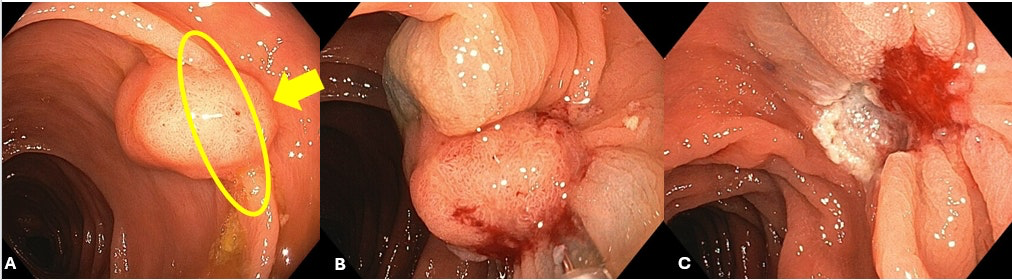
By visual analysis, the lesion appeared resectable. However, two findings on closer inspection raised concern.
- The polyp appeared to involve part of the fold (oval, panel A). This indicates the lesion may extend deeper than the surface appearance suggests.
- There was a subtle depression below the lesion (yellow arrow, panel A). Depressed morphology within a flat or sessile lesion is a red flag for submucosal invasion.
Based on these findings, submucosal injection was performed to assess lifting. The lesion did not lift (panel B), indicating firm attachment to the submucosa. Non-lifting sign in this context is highly suspicious for at least T1 invasion.
Resection was performed nonetheless (panel C). In cases of suspected high-grade dysplasia or early cancer, endoscopic resection of a large piece is preferred over biopsy: biopsies frequently yield misdiagnosis, often reading as high-grade dysplasia when the lesion is already invasive adenocarcinoma.
Final Diagnosis
Invasive adenocarcinoma. The patient will undergo hemicolectomy.
This case underscores a key teaching point: visual resectability and histologic outcome do not always align. In Lynch Syndrome patients, the index of suspicion for malignant transformation must be high even in lesions that appear endoscopically manageable.
Key Takeaways
- Paris 0-Is + Kudo IIIL: Sessile lesion with irregular pit pattern. Always assess for fold involvement and depressed morphology before assuming resectability.
- Non-lifting sign: Submucosal injection is not optional when any depressed component is present. Failed lifting shifts the differential toward T1 or deeper invasion.
- Resect, do not biopsy: In suspected early cancer, large-piece resection provides a tissue specimen that accurately stages the lesion. Biopsy alone commonly under-stages these lesions.
- Lynch Syndrome context: Accelerated adenoma-to-carcinoma sequence. Even small or morphologically “benign” appearing lesions require careful evaluation.
Enjoyed this case?
EndoCollab members get access to our full course video library: hands-on endoscopy technique taught by Klaus Monkemuller, MD, PhD. Over 200 videos covering hemostasis, resection, ERCP, lesion characterization, and more. The library you will actually use before cases.