A 7-minute guide to Prague C and M: find the tongues, measure circumferential and maximal extent at the incisors, then plan Seattle biopsies.
If the next endoscopist opens your note and only sees “short Barrett” or “long tongues,” can they reconstruct the segment? Prague C and M is the shared language: C is circumferential extent, M is the maximal extent to the tip of the most proximal tongue, both subtracted from the GE junction depth at the incisors. This clip is from the full-course Prague classification lecture.
Why “short Barrett” fails the next case
Barrett’s comes as one tongue, many tongues, or a circumferential sleeve with no tongues at all. A photo helps. A number pair lets another endoscopist, a pathologist, and you in two years know what was actually there.
Once the GE junction is already marked at the incisors, the work is three looks: how far proximal is the Z line, where does the circumferential columnar lining end, and where does the most proximal tongue end.
I then subtract those depths from the GE junction. The WEO poster on screen is one worked case. The overlay I walk through is another. Do not copy the poster numbers onto a different esophagus. The five steps below start at the IWGCO poster’s Step 3 (tongues and Z-line). Poster Steps 4 and 5 are this guide’s Steps 2 and 3.
Step 1: Find the tongues and the proximal Z-line shift
Look how far up the columnar epithelium has gone. How long are the tongues? How far has the Z line moved proximal to the GE junction? That is the Prague step that comes right before you start measuring.
Video moment @ 0:08
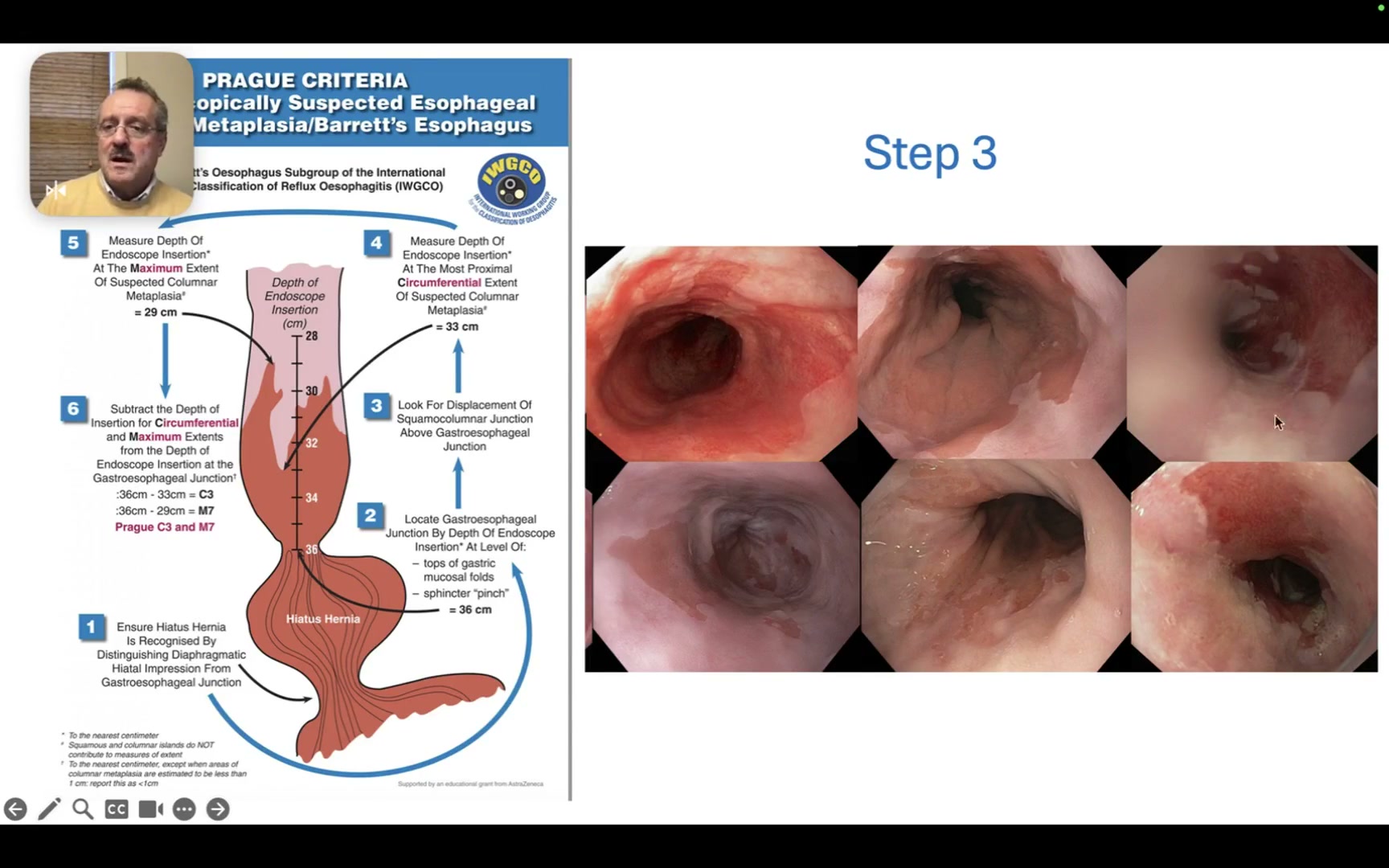
Significance: If you skip the tongue map, C and M become two guessed numbers instead of two measured landmarks.
Step 2: Measure C at the incisors
Pull the scope back and watch where the circumferential columnar lining ends. Read that depth at the incisors. In the case I walk, the GE junction is at 36 cm and the circumferential extent is at 33 cm. 36 minus 33 is C3.
Video moment @ 0:35
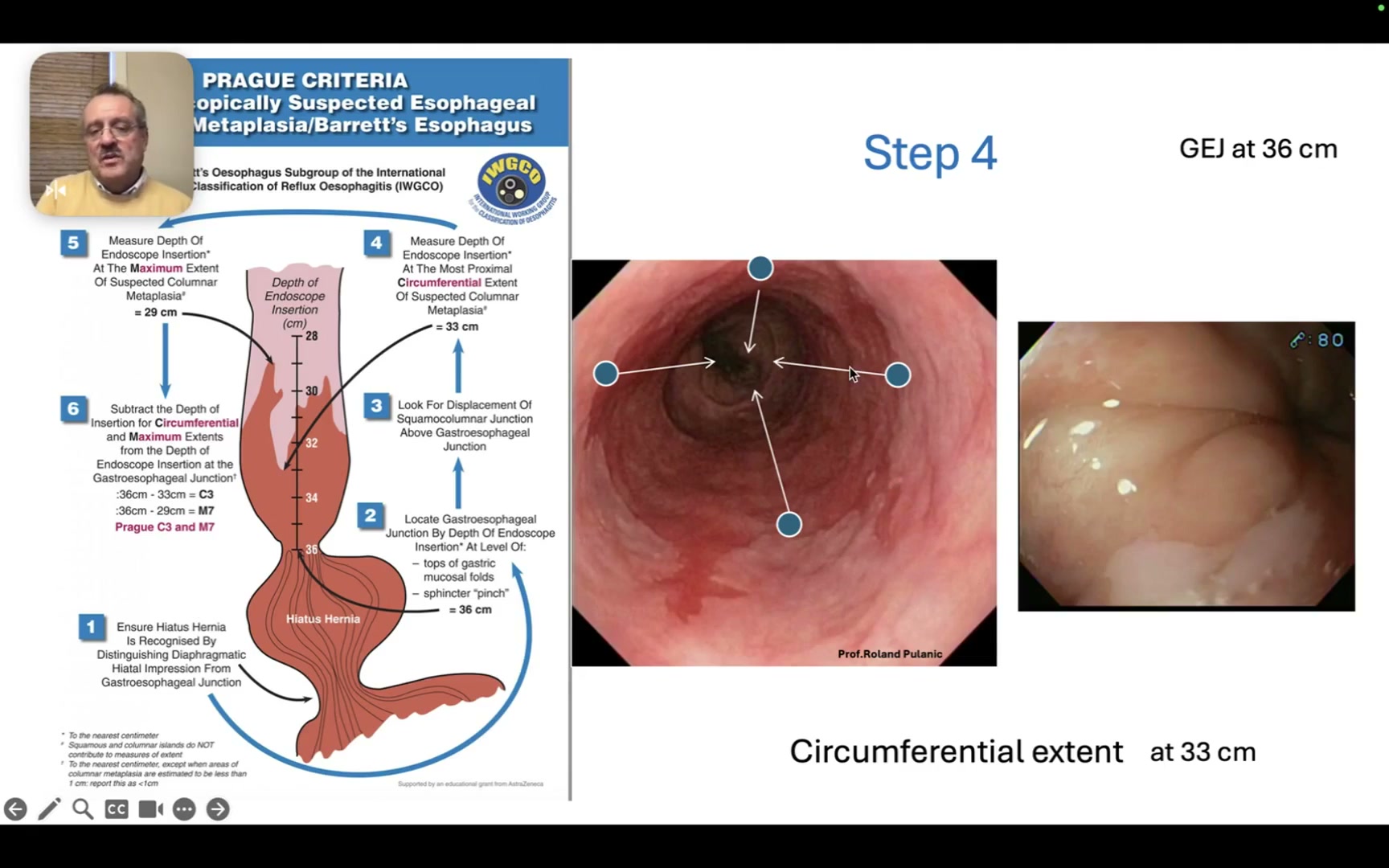
Significance: C is the circumferential sleeve, not the longest tongue. Measure it first and remember the number before you chase M.
Step 3: Measure M at the most proximal tongue
Keep pulling and find where the most proximal tongue ends. In the same case the tongue reads 32 cm at the incisors. 36 minus 32 is M4. Circumferential 3 cm, maximal 4 cm: Prague C3 M4.
Video moment @ 1:30
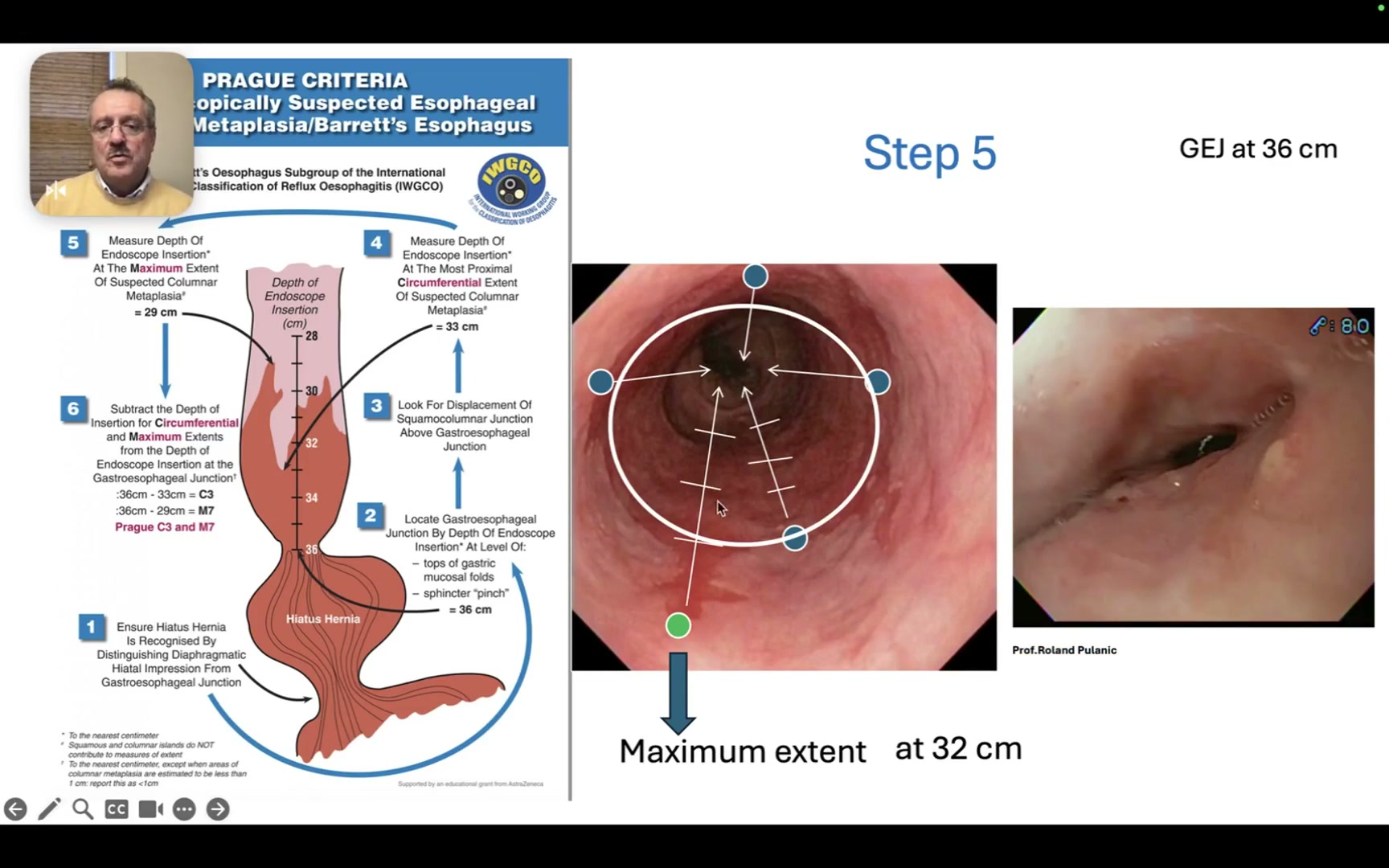
Significance: M is always at least as large as C. If your M is smaller than C, you swapped the landmarks.
The result you want in the note looks like this:
Report line: Prague C3 M4
How do you calculate Prague C and M from the incisors?
Subtract the C and M landmark depths from the GE junction depth measured at the incisors. C is the most proximal circumferential extent. M is the most proximal tongue. In the walked case, GEJ 36 cm minus C at 33 cm is C3, and 36 cm minus M at 32 cm is M4.
Continue with a membership
Unlock worked C2 M4, C2 M6, and C3 M7 examples, plus the Seattle start I actually use and the paste-ready report line.
Same format as our other step-by-step lecture guides: actionable steps you can use on the next case.
Already a member? Log in
Continue reading with a membership
Get access to the full content, course videos, case library, and our private WhatsApp community.
Already a member? Log in
We protect your privacy. No spam. Unsubscribe anytime.